Best Espresso Machines for Home in 2026
The Breville Bambino Plus at $485.00 is the espresso machine most people should buy: 9 bar at the puck, a 3 second heat-up and automatic milk texturing in 7.7 inches of counter, with no built-in grinder so the grinder budget stays intact. Pay $669.99 for the Breville Barista Express if you want the grinder in the same box, and $1,599.95 for the Breville Dual Boiler only if you steam milk for several drinks back to back.
The Breville Bambino Plus at $485.00 is the espresso machine most people should buy. It reaches brew temperature in about 3 seconds, delivers 9 bar at the coffee bed, textures milk automatically and takes up 7.7 inches of counter. What it deliberately lacks is a built-in grinder, and that omission is the reason it wins at this price: the grinder is the component that sets the ceiling on how good your espresso can be, and a machine that leaves it out leaves the money for it.
What does an espresso machine actually do for the money?
An espresso machine is a pump and a heater: it forces water held between 90 and 96 C through a compacted bed of about 18 g of finely ground coffee at roughly 9 bar of pressure, producing about 36 g of liquid in 25 to 30 seconds. Every machine on this page does that. The price difference buys four specific things, and it is worth naming them plainly because none of them is "better espresso" in the abstract.
The first is temperature stability. A cheap thermoblock heats water on demand and lets the temperature drift across the shot, which shifts the extraction from the first second to the last. PID control keeps the brew water inside a narrow band, which is what makes a recipe repeatable tomorrow. Both the Bambino Plus and the Barista Express have digital PID, which is why the useful floor for real espresso now sits near $300 rather than near $700.
The second is steam power. Texturing milk means injecting air into it while spinning it into a vortex, and that needs enough steam pressure to move 12 oz of milk without stalling. A small single boiler makes a competent 6 oz latte and struggles with two in a row. A dual boiler steams while it brews, at full pressure, indefinitely.
The third is build and serviceability. The Gaggia Classic Evo Pro at $499.00 uses a brass group, a commercial 58 mm portafilter and a solenoid valve, and it can be rebuilt with hand tools. The Rancilio Silvia at $995.00 uses a 12 oz brass boiler and a commercial group in a home body. Those machines cost more to make and last longer, and neither is faster or more automatic than a Breville at half the price.
The fourth is automation. Assisted tamping, automatic milk texturing, dose correction and volumetric shot control all remove steps, and removing steps genuinely helps a beginner get a drinkable result in the first week. They do not raise the ceiling. They lower the floor, which is a different and often more valuable thing.
The three machines worth most people's money

Breville BES500BSS Bambino Plus Espresso Machine
A 3 second heat-up thermojet, 9 bar pressure and automatic milk texturing in a machine only 7.7 inches wide. No built-in grinder, which is the point: it leaves the grinder budget free.
Best for: A first real espresso machine paired with a separate burr grinder.
Check price
Breville BES870XL Barista Express Espresso Machine
The default recommendation for a decade because it is a complete setup in one box: conical burr grinder, 54mm portafilter, steam wand and a 67 oz tank.
Best for: One purchase, one footprint, no separate grinder to buy or house.
Check price
Breville BES920XL Dual Boiler Espresso Machine
Separate brew and steam boilers with PID control, so you pull and steam simultaneously at independently set temperatures. A 58mm commercial portafilter opens up the whole accessory ecosystem.
Best for: Households pulling several milk drinks back to back, or anyone chasing repeatable shot temperature.
Check pricePrices change often, confirm on Amazon. As an Amazon Associate we earn from qualifying purchases.
Why does the grinder decide the ceiling, not the machine?
Because grind size is the only variable that meaningfully controls how long the shot takes. Water at 9 bar takes the path of least resistance through the puck. If the grounds are too coarse, water rushes through in 15 seconds and the shot comes out sour and thin, because too little of the coffee dissolved. If they are too fine, it crawls past 40 seconds and the shot tastes bitter and drying. The target window for extraction yield, the percentage of the dry coffee that ends up dissolved in the drink, is about 18 to 22 percent, and grind is the dial that moves you inside it.
A grinder that cannot hold a fine, repeatable setting simply cannot land in that window reliably. Blade grinders chop rather than mill and produce every particle size at once, so part of the puck over-extracts while part is still under-extracted no matter what the machine does. Cheap burr grinders can grind fine enough but jump too far between settings, so the shot is either 18 seconds or 38 seconds with nothing usable in between.
This is why the Bambino Plus is the right recommendation and a $700 all-in-one often is not. At a $900 total, $884.00 buys the Bambino Plus and the MiiCoffee DF64 II with 64 mm flat burrs and stepless adjustment, and that setup will out-pull a single $900 machine with a convenience grinder bolted to its side. At a smaller total, $684.95 buys the Bambino Plus and the Baratza Encore ESP , which has 20 micro-adjustments inside the espresso range and published parts diagrams so it is repairable rather than disposable. The grinder versus machine budget calculator splits any total you give it, and the espresso grinder roundup covers the grinder side properly.
How do these machines compare on paper?
Below are the published figures that actually differ between machines: what heats the water, what size portafilter it takes, whether brew temperature is PID controlled, and how long it takes to be ready. Where a manufacturer does not publish a heat-up time we say so rather than repeat a number from a forum, because you cannot tell an invented specification from a verified one by looking at it.
| Model | Boiler type | Portafilter | PID | Warm-up | Price |
|---|---|---|---|---|---|
| Breville Bambino Plus | ThermoJet single boiler | 54 mm | Yes, digital PID | 3 seconds | $485.00 |
| Breville Barista Express | Thermocoil single boiler | 54 mm | Yes, digital PID | Not published | $669.99 |
| Breville Barista Pro | ThermoJet single boiler | 54 mm | Yes, digital PID | 3 seconds | $849.95 |
| Gaggia Classic Evo Pro | Single aluminium boiler | 58 mm | No, thermostat controlled | Not published | $499.00 |
| Rancilio Silvia | Single brass boiler, 12 oz | 58 mm | No on the base model | Not published | $995.00 |
| Breville Dual Boiler | Dual boiler, both PID controlled | 58 mm | Yes, on both boilers | Not published | $1,599.95 |
| Breville Oracle Jet | ThermoJet heating system | 58 mm | Yes, digital PID | 3 seconds | $1,929.99 |
Two rows in that table deserve reading twice. The Gaggia Classic Evo Pro has no PID and yet costs more than the Bambino Plus, because you are buying a 58 mm commercial group and a machine designed to be opened rather than a machine designed to be fast. And the Breville Barista Pro differs from the Barista Express mainly by heating method, which is a workflow difference rather than a cup difference, worked through in Barista Express versus Barista Pro.
Other machines worth shortlisting

Gaggia RI9380/49 Classic Evo Pro Espresso Machine
A commercial 58mm portafilter, a brass group and a solenoid valve in a machine you can rebuild with hand tools. The modification community around it is enormous.
Best for: People who want a machine they can maintain and upgrade for years rather than replace.
Check price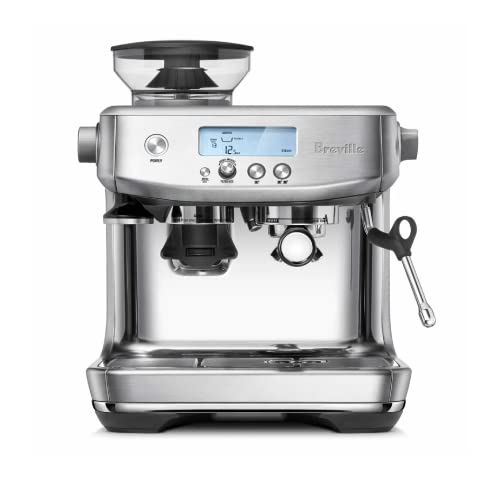
Breville BES878BSS Barista Pro Espresso Machine
The Barista Express with a thermojet heater and a digital display, so it is ready in seconds rather than minutes.
Check price
Rancilio Silvia Espresso Machine
A commercial brass group and a 12 oz brass boiler in a single boiler home body. Famously durable, famously unforgiving about temperature timing.
Check price
Breville BES985BSS Oracle Jet Espresso Machine
Automates grinding, dosing, tamping and milk texturing while still letting you set the shot parameters yourself.
Check pricePrices change often, confirm on Amazon. As an Amazon Associate we earn from qualifying purchases.
Do you need a dual boiler to make a latte?
No. You need a dual boiler to make several lattes without waiting, which is a different claim and the honest one. Boiler architecture is a workflow decision, not a flavour decision, and it is routinely sold as though it were the reverse.
A single boiler machine has one heating element that has to be at roughly 93 C to brew and roughly 130 C to make steam. It cannot be at both temperatures at once, so you pull the shot, press the steam switch, wait for the boiler to climb, texture the milk, then wait or purge to bring it back down before the next shot. On a small thermoblock that transition takes seconds. On a brass boiler it takes longer. Either way, the coffee in your cup is identical to what a dual boiler would have produced at the same temperature and the same recipe.
A dual boiler has two, each with its own PID, so brewing and steaming happen simultaneously at independently set temperatures. That saves 20 to 40 seconds per drink and, far more importantly, removes the temperature surfing that a single boiler demands when you make four drinks in a row. Nobody making one flat white a day notices. Somebody making breakfast for four people notices immediately.
There is a third architecture, the heat exchanger, which draws brew water through a tube passing through the steam boiler so one boiler serves both jobs at once. It is the traditional cafe answer and it brings its own quirk, the cooling flush. If you are choosing between architectures rather than between brands, read single boiler versus dual boiler before you shortlist anything.
Does 58 mm or 54 mm change what you can buy later?
Yes, and this is the decision that quietly constrains every purchase you make afterwards. Portafilter diameter is not a taste specification. It is a compatibility standard, and it is not interchangeable.
58 mm is the commercial size. Precision baskets, naked portafilters, distribution tools, puck screens, dosing funnels and calibrated tampers are all made in 58 mm first, by many manufacturers, at competitive prices. The Gaggia Classic Evo Pro, the Rancilio Silvia, the Breville Dual Boiler and the Breville Oracle Jet all take it, which means a $36.92 precision basket or a $79.95 naked portafilter bought today still fits the machine you upgrade to in five years.
54 mm is the Breville size used on the Bambino , Bambino Plus, Barista Express, Barista Express Impress and Barista Pro. The accessories exist, and they are perfectly good, but the selection is narrower and the prices are higher because fewer people make them. If you buy a 54 mm machine and later move to a 58 mm one, none of your puck prep hardware moves with you.
This is not a reason to avoid Breville. It is a reason to make the choice deliberately rather than discover it after spending $150 on tools. The portafilter basket size chart lists which machine takes which size, and the machine database carries the specification on every individual model page.
Who should not buy the Breville Dual Boiler?
Anyone who drinks one black espresso a day. This is the clearest case on the page, and it is worth doing the arithmetic. The Breville Dual Boiler costs $929.96 more than the Barista Express. That premium is 58 percent of the machine's total price, and almost all of it buys one capability: brewing and steaming at the same time. If you never steam milk, you are paying over half the price of the machine for a boiler you will switch on twice a year.
Buy the Breville Barista Express at $669.99 instead if you want the grinder included and one footprint on the counter. Buy the Gaggia Classic Evo Pro at $499.00 instead if you want a 58 mm commercial group, a machine you can service yourself, and $1,100.95 left over. That leftover buys a very good grinder, a scale, a precision basket and a year of coffee, and every one of those changes the cup more than the second boiler would have.
Anyone who has not yet bought a burr grinder should also skip it. A dual boiler paired with pre-ground supermarket coffee produces a temperature-stable bad shot. The machine cannot fix an uneven puck, because water still finds the fastest channel through it regardless of how precisely the water was heated. Spend the first $399.00 on a grinder and the argument for a dual boiler can wait a year without costing you anything.
Anyone in a small kitchen should think twice as well. Dual boilers are large, heavy and need clearance above for the tank and behind for airflow. If counter depth is the binding constraint rather than budget, the De'Longhi Dedica Arte Espresso Machine at $299.95 is 5.9 inches wide and the Bambino Plus is 7.7, and both leave room for a grinder beside them.
What should you budget in total, not just for the machine?
A machine is between roughly 55 and 70 percent of a working espresso setup. The rest is a grinder, a scale reading to 0.1 g, a tamper sized to your basket, a distribution tool and a knock box. None of those is optional in practice: without a scale you cannot know your dose, and without a known dose the ratio that defines the drink is a guess.
A realistic entry total is $684.95 for the Bambino Plus and the Encore ESP, plus about $80 for a scale, tamper and distribution tool. A realistic intermediate total is $898.00 for the Gaggia Classic Evo Pro and the DF64 II, into which a 58 mm precision basket and naked portafilter drop straight in. The three complete coffee bar builds price all of this out with running totals, and the espresso machine buying guide walks the decision in order rather than by product.
One line people forget: water. Espresso machines scale from calcium and magnesium, and the commonly cited target is roughly 50 to 100 ppm total hardness as calcium carbonate with alkalinity near 40 ppm. Above about 120 ppm, filtration or blended distilled water is the answer rather than descaling more often, because you are treating the symptom instead of the input.
What do you still have to learn after the machine arrives?
The recipe, and it is short. A conventional double is 18 g of coffee in, 36 g of espresso out, in 25 to 30 seconds. That is a 1:2 ratio. Tighter to 1:1 or 1:1.5 is a ristretto, longer to 1:2.5 or 1:3 is a lungo. Weigh the dose, weigh the yield, time the shot, and change exactly one variable at a time.
From there the whole troubleshooting tree is two branches. Sour and thin means under-extracted, so grind finer or raise the temperature. Bitter, drying and ashy means over-extracted, so grind coarser or lower the temperature. Lighter roasts want the top of the 90 to 96 C range and darker roasts the bottom. Beans want to be roughly 7 to 21 days off roast, because carbon dioxide from roasting disrupts extraction before that and the coffee stales after it.
Milk is a separate skill with a narrower target: texture to 55 to 65 C. Above roughly 70 C the proteins denature and the milk tastes scalded, and lactose sweetness peaks near 60 C, which is why a well steamed latte tastes sweet with no sugar in it. Nothing about that changes between a $485 machine and a $1,600 one. The expensive machine simply lets you do it twice in a row without waiting.
Frequently asked questions
What is the best espresso machine for most people?
The Breville Bambino Plus at $485.00. It holds 9 bar at the puck, reaches brew temperature in about 3 seconds, textures milk automatically and occupies 7.7 inches of counter. It has no built-in grinder, which is the point: paired with a $199.95 Baratza Encore ESP it becomes a genuinely capable setup for roughly $684.95, and the grinder is the component that decides how good the coffee can get.
Do I need a dual boiler espresso machine at home?
Only if you make several milk drinks back to back. A dual boiler brews and steams at the same time at two independently set temperatures, so there is no waiting between the shot and the milk. If you pull one or two drinks each morning, a single boiler costs you about 20 to 40 seconds of switching time per drink, which is not worth $1,599.95 on its own.
Is 58 mm better than a 54 mm portafilter?
Not for taste, but 58 mm is the commercial standard, so precision baskets, naked portafilters, tampers, puck screens and distribution tools are all cheaper and more widely available in that size. Breville uses 54 mm on the Bambino and Barista lines, and those parts exist but the selection is thinner. Choose the size first, because every accessory you buy afterwards is locked to it.
Should I buy a machine with a built-in grinder?
It depends on counter space more than on quality. The Breville Barista Express at $669.99 puts a conical burr grinder, a 54 mm portafilter and a steam wand in one footprint, which suits a small kitchen. A separate grinder such as the MiiCoffee DF64 II at $399.00 grinds better and can be upgraded independently, but it needs its own space and its own budget line.
How much should I spend on the grinder versus the machine?
A common working rule is to put roughly a third to a half of a total espresso budget into the grinder. Grind size is the only variable that meaningfully controls how long a shot takes, so a machine paired with a grinder that cannot hold a fine, repeatable setting will never pull a balanced shot no matter how stable its brew temperature is.
Do home espresso machines really run at 9 bar?
At the puck, yes, on any machine worth buying. Most home pumps are rated at 15 bar, and an over-pressure valve bleeds the excess so the coffee bed sees roughly 9 bar. The 15 bar figure on the box is a pump specification, not a brewing one, and a higher number on a spec sheet does not indicate a better machine.
How we choose: we compare published manufacturer specifications, verified owner reviews and published barista guidance. We do not test gear in person. Espresso machines run mains electricity, pressurised water and steam above boiling point, so follow your manufacturer's manual and leave electrical or boiler work to a qualified technician. Everything here is researched guidance, not professional advice.