Best Espresso Tampers in 2026: Size, Calibration and What Actually Matters
The Normcore 58.5mm Coffee Tamper V4 at $42.99 is the espresso tamper most people should buy, because it ships with 15 lb, 25 lb and 30 lb springs and makes every tamp identical. Tamp pressure matters far less than people think: past roughly 15 to 20 kg the puck is already as compressed as it is going to get, and a heavier tamp barely slows the shot. What matters is that the tamp is level and consistent, and that the tamper matches the basket, which means a 58.5 mm tamper for a 58 mm portafilter.
The Normcore 58.5mm Coffee Tamper V4 at $42.99 is the espresso tamper most people should buy. It ships with 15 lb, 25 lb and 30 lb springs, which settles the pressure argument by fitting a part rather than by feel, and it is the right diameter for a 58 mm basket. Buy it, stop thinking about tamping, and spend your attention on distribution instead.
Does tamp pressure actually change the shot?
Tamping is the act of compressing loose ground coffee into an even, level puck so that pressurised water passes through all of it at the same rate instead of finding a fast lane through the loosest part. Read that definition carefully and you will notice that "even" and "level" are doing all the work, and that "hard" is not in it anywhere.
This is the least popular fact in the category and the most useful one. Past roughly 15 to 20 kg of force, the coffee bed is already about as compressed as it is going to get. The particles have locked together, the air has been driven out, and adding another 10 kg of effort changes the density of the puck by a small enough margin that shot time barely moves. People spend years trying to tamp harder and more evenly, and only the second half of that sentence was ever worth the effort.
Level is different, and level is where shots are actually lost. A puck that sits 1 mm higher on one side is a puck with a thinner path on the other, and water at 9 bar finds that path in under a second. The result is a shot that sprays sideways from a bottomless portafilter, runs fast, and tastes sour and thin because most of the water went through a fraction of the coffee. That is channelling, and a tilted tamp is one of its three common causes.
Consistency is the other half. If you tamp at 12 kg on a rushed weekday and 25 kg on a relaxed weekend, shot time moves and you will blame the grinder. Not because 12 kg is wrong, but because it is different from yesterday. This is precisely what a calibrated spring gives you: a mechanism that clicks at the same force every single time, removing a variable rather than optimising it. That is the correct way to think about the money in this category. You are not buying pressure. You are buying the elimination of a variable.
And distribution matters more than either. What you do to the coffee before the tamp, breaking up clumps and levelling the bed, has a larger effect on channelling than anything you do with the tamper. The espresso puck prep guide covers the whole sequence, and the order it recommends is not an accident: distribute first, tamp second, and expect the first step to fix more problems.
Espresso tampers by tier

Normcore 58.5mm Palm Tamper with 30lb Spring
A palm shape puts your weight straight down the axis, which is the actual fix for a tilted puck. The built-in spring stops at 30 lb every time.
Best for: Anyone whose shots run fast on one side of the basket.
Check price
Normcore 58.5mm Coffee Tamper V4, Spring-Loaded
Ships with 15 lb, 25 lb and 30 lb springs, so you can settle the pressure question by swapping a part rather than by feel.
Best for: A 58mm machine where you want tamp pressure removed as a variable.
Check price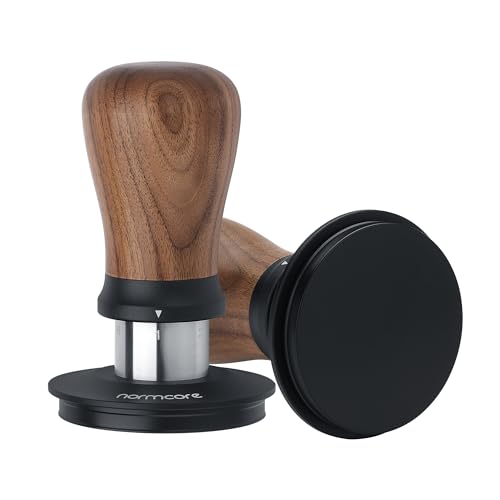
Normcore 58.5mm Espresso Tamper V5
Six pressure settings on one tri-spring mechanism plus a titanium coated flat base, so no spring swapping at all.
Best for: Households where two people tamp differently, or anyone testing pressure against yield.
Check pricePrices change often, confirm on Amazon. As an Amazon Associate we earn from qualifying purchases.
What size tamper do you need?
Fit is the specification that actually decides the purchase, and it is the one people get wrong most often. A 58 mm portafilter basket takes a 58.5 mm tamper. A 54 mm Breville basket takes a 54 mm tamper. Those are not approximations to be rounded off, and the half millimetre on the 58 mm size is the entire point rather than a manufacturing quirk.
Here is why. A basket described as 58 mm has an internal diameter slightly over 58 mm, and a 58.5 mm tamper is cut to leave only a hair of clearance so it can still enter without binding. A tamper noticeably narrower than the basket, say a 57 mm tamper or the plastic one that came in the box, leaves a ring of uncompressed coffee around the whole circumference. Water finds it immediately, because uncompressed coffee is the loosest path available and it runs in a circle around the entire edge of the puck.
The ring is bigger than it sounds, because area grows with the square of the radius. A ring only 0.5 mm wide around a 58.5 mm basket is 3.4 percent of the puck face. Widen that gap to 1 mm and it is 6.7 percent. Losing seven percent of your coffee bed to a fast lane is not a subtle defect, and no amount of tamping force fixes it, because the ring is exactly the part the tamper never touched.
So the first thing to check is your portafilter size, not the tamper price. Breville Bambino, Bambino Plus, Barista Express, Barista Pro and Barista Touch machines use 54 mm. Gaggia Classic Evo Pro, Rancilio Silvia, the Breville Dual Boiler and essentially every prosumer machine use 58 mm. The portafilter basket size chart lists them, and it is worth two minutes before you order, because none of the Normcore tampers on this page fits a 54 mm machine.
If you own a Breville with a 54 mm portafilter, the sensible purchase is the Reoszeank 54mm accessories kit at $29.99, which bundles a correctly sized tamper, a WDT tool and a dosing funnel in one order. Buying the same three tools separately at 54 mm usually costs more and arrives in three deliveries, and it is the single most common accessory mistake on this site.
| Tamper | Diameter | Calibrated | Spring rating | Base shape | Price |
|---|---|---|---|---|---|
| Normcore Palm Tamper, 30 lb spring | 58.5 mm | Yes, fixed | 30 lb, not swappable | Flat | $32.99 |
| Normcore Coffee Tamper V4, spring-loaded | 58.5 mm | Yes, swappable springs | 15 lb, 25 lb and 30 lb supplied | Flat | $42.99 |
| Normcore Espresso Tamper V5 | 58.5 mm | Yes, six settings | Tri-spring, six pressure settings | Flat, titanium coated | $79.99 |
| Reoszeank 54 mm kit tamper | 54 mm | No | None | Flat | $29.99 |
| Plastic tamper supplied in the box | Usually 1 to 2 mm under the basket | No | None | Flat | Not published |
The last row is the one worth reading twice. The tamper supplied in most machine boxes is typically a millimetre or two under the basket diameter, uncalibrated, and often plastic. It is not a bad tamper because it is cheap. It is a bad tamper because it is the wrong size, and the wrong size is the only failure in this category that a technique cannot compensate for.
Are calibrated and spring-loaded tampers worth it?
Yes, for about ten dollars, and then no.
A calibrated tamper has a spring in the handle that compresses and clicks when you reach a set force. You press until it clicks, then stop. The result is that tamp pressure stops being something you feel and becomes something you hit, exactly the same way every time, whether you are awake or not. That is the whole value proposition, and it is a real one, because the fastest way to make a variable stop mattering is to make it stop varying.
The Normcore V4 at $42.99 is $10.00 over the Normcore palm tamper at $32.99, and what that buys is three springs instead of one. In practice most people fit the 25 lb or 30 lb spring, pull shots for a month and never touch it again. The reason to have the other springs is not that you will use them daily, it is that you can answer the pressure question empirically once, on your own machine, and then stop wondering.
The Normcore V5 at $79.99 replaces the swappable springs with a tri-spring mechanism offering six pressure settings and adds a titanium coated flat base. It is $37.00 more than the V4. The engineering is genuinely nicer. The shot is not, unless you are running a household where two people tamp differently and want a dial rather than a toolkit, or you are deliberately testing pressure against yield as an experiment.
A note on base shape while we are here. Flat bases are the default and the right choice for almost everyone. Ripple or convex bases exist and have advocates, and the differences they make are small compared to whether the tamp was level and whether the coffee was distributed first. If you are choosing between a flat tamper you can afford and a ripple base you cannot, the question answers itself.
What about a palm tamper?
A palm tamper is a short puck-shaped tamper with no handle. You press it with the flat of your hand, straight down through the axis of the basket, rather than gripping a handle that gives your wrist room to lean.
That geometry is the actual argument for it. Most tilted tamps come from the same source: a handle held at a slight angle, or a wrist that pushes forward as it pushes down because the machine is at the wrong counter height. A palm shape makes it awkward to apply force in any direction other than straight down, so it fixes a common fault mechanically instead of asking you to be careful.
The trade is that a fixed 30 lb spring gives you no adjustment at all, and the shape is less comfortable if you have hand or wrist problems, because the force goes through your palm rather than through a grip. If your shots come out of a bottomless portafilter spraying consistently from one side, this is the tamper to buy. If your shots are already symmetrical, the V4 is the more flexible tool for ten dollars more.
Whichever you choose, put a Normcore tamping mat at $16.59 under the portafilter. Tamping on a bare stone counter chips both the counter and the portafilter spouts, and a corner mat supports the spouts while you press so the whole assembly stays square. It is the cheapest item mentioned on this page and the one people are most glad they bought.
Is a tamper more important than a distribution tool?
No. Not close. If you have one purchase to make in puck prep, make it the distribution tool.
The reason is mechanical. A grinder throws coffee into the basket in clumps, especially at espresso fineness where static and fines make grounds stick together. A tamper presses down on whatever arrangement it finds. Press a clumpy bed and you get a compressed clumpy bed: dense where the clumps were, loose between them, and water goes through the loose parts. The tamper never had the ability to fix that, because compressing an uneven thing evenly still leaves it uneven.
A Normcore WDT Distribution Tool V3 at $32.69 stirs those clumps apart with nine fine needles before the tamp. That single step removes the most common cause of channelling in a home setup, and it costs less than the tamper it precedes. This is why the roundup order on this site puts the distribution tool first at every budget.
The second highest value item is a precision basket. An IMS 58mm 18g Baristapro basket at $36.92 has laser-cut holes with even spacing and consistent open area, against the stamped basket in most boxes where hole size and distribution vary visibly across the base. An uneven basket creates uneven flow no matter how perfect the puck above it is. Add a Normcore magnetic dosing funnel at $23.99 and grounds land inside the basket rather than on the counter, which is a tidiness fix that turns out to be a consistency fix too, because coffee on the rim is coffee that was not in your dose.
Add those up and the arithmetic is blunt. The WDT tool and the precision basket together are $69.61, which is $10.38 less than the V5 tamper on its own, and they fix considerably more channelling. The full puck prep stack of distribution tool, precision basket, dosing funnel and tamping mat comes to $110.19, and that stack plus a $32.99 palm tamper beats any tamper in the world used alone.
Who should not buy the Normcore V5?
Anyone who does not yet own a distribution tool or a precision basket. Both fix more channelling per dollar than a better tamper does, and both fix problems the tamper is physically incapable of addressing. Spending $79.99 on a six-setting tamper while stirring nothing and pulling through a stamped basket is spending money on the last step of a process whose first two steps are still broken.
The order that actually works is: distribution tool, precision basket, calibrated tamper, then everything else. If you follow it you will have spent $69.61 before you buy a tamper at all, and the $42.99 V4 on top of that produces better shots than the $79.99 V5 sitting alone on the counter ever will.
Anyone still using the tamper that came in the box should also skip it, for a different reason: the upgrade you need is a correctly sized tamper, not an adjustable one. Going from an undersized plastic tamper to a properly fitting 58.5 mm one is a large improvement. Going from a properly fitting fixed-pressure tamper to a properly fitting six-setting tamper is a small one. Buy the size, not the mechanism.
And anyone whose shots are inconsistent despite good puck prep should stop shopping in this category entirely. That symptom points at the grind, and no tamper at any price addresses it. The dialling in guide works through how to tell the two apart, and the coffee bar setups pages show where the tamper sits in a build where the money went to the right places first.
Frequently asked questions
What is the best espresso tamper?
The Normcore 58.5mm Coffee Tamper V4 at $42.99 for a 58 mm machine. It ships with 15 lb, 25 lb and 30 lb springs, so the tamp pressure question is settled by fitting a part rather than by feel, and every tamp after that is identical. The cheaper Normcore palm tamper at $32.99 does the same job with a fixed 30 lb spring and a palm shape that helps if your tamps come out tilted.
How hard should you tamp espresso?
Consistently, and level, at somewhere around 15 to 20 kg of force. Past that point the coffee bed is already about as compressed as it will get, and pressing harder does not slow the shot much further. What genuinely ruins a shot is a tamp that leans, because water follows the shallow side. A calibrated tamper removes the pressure variable entirely so you can concentrate on keeping the base level.
What size tamper do you need?
Match the basket, then add half a millimetre. A 58 mm portafilter takes a 58.5 mm tamper, and a 54 mm Breville takes a 54 mm tamper. The half millimetre exists because a tamper noticeably narrower than the basket leaves an unpressed ring of coffee around the edge, and water always takes the loosest path it can find. Check your portafilter size before ordering anything.
Is a distribution tool more important than a tamper?
Yes, clearly. A tamper compresses whatever arrangement of coffee is already in the basket, and it cannot fix clumps or an uneven bed. A WDT tool stirs those clumps apart before the tamp, which is where most channelling actually starts. If you can only buy one, buy the distribution tool at $32.69 and tamp with whatever came in the box.
Are spring-loaded tampers worth the money?
They are worth it for consistency rather than for pressure. A spring clicks at the same force every time, so a variable that used to drift with your mood, your grip and your counter height simply stops moving. That is worth roughly ten dollars over a plain tamper. It is not worth abandoning a distribution tool or a precision basket to afford, because both fix more channelling per dollar.
Do you still need to tamp if you use a puck screen?
Yes. A puck screen sits on top of the tamped bed and spreads incoming water, which keeps the shower screen cleaner and reduces surface disruption. It does nothing to compact the coffee underneath it. Tamping and screening solve different problems: one creates an even bed of the right density, the other protects the surface of that bed from the incoming jet.
How we choose: we compare published manufacturer specifications, verified owner reviews and published barista guidance. We do not test gear in person. Espresso machines run mains electricity, pressurised water and steam above boiling point, so follow your manufacturer's manual and leave electrical or boiler work to a qualified technician. Everything here is researched guidance, not professional advice.