Best Espresso Grinders Under $500 in 2026
The MiiCoffee DF64 II at $399.00 is the best espresso grinder under $500: 64 mm flat burrs, stepless adjustment and near-zero retention. Under $500 is the band where a grinder becomes genuinely espresso-capable, and the specification that decides it is adjustment resolution, not price. A grinder with too few positions inside the espresso range cannot land a 25 to 30 second shot even when the dose, temperature and puck prep are all correct. The Baratza Encore ESP at $199.95 is the sensible floor, with 20 micro-adjustments inside the espresso range.
The MiiCoffee DF64 II at $399.00 is the best espresso grinder under $500. It pairs 64 mm flat burrs with stepless adjustment and near-zero retention, which is the combination that lets you move a shot by a second at a time and weigh out almost exactly what you weighed in. Under $500 is the band where a grinder stops being a coffee chopper and becomes an espresso instrument, and the specification that decides it is not price or burr size. It is adjustment resolution.
What makes a grinder espresso-capable rather than just good?
An espresso grinder is a burr mill that can hold a fine, repeatable setting inside a narrow band, roughly the size of table salt down to powdered sugar, and move within that band in increments small enough to change a shot by a second or two. That is the whole requirement, and it is much harder to build than a grinder that makes a good French press.
The reason is physics rather than marketing. Water at 9 bar takes the path of least resistance through the coffee bed, and grind size is what sets that resistance. Too coarse and the shot rushes out in 15 seconds, sour and thin, because too little of the coffee dissolved. Too fine and it crawls past 40 seconds and reads bitter and drying. The conventional target is an 18 g dose yielding 36 g in 25 to 30 seconds, and the target extraction window is 18 to 22 percent of the dry coffee mass dissolved into the cup. Grind is the dial that moves you inside it.
That window is narrow in physical terms. The distance in microns between a 22 second shot and a 32 second shot is small, and a filter grinder simply has no resolution there. It might offer 40 positions spread across everything from espresso to cold brew, of which perhaps eight fall inside the espresso range. Eight positions to cover the entire useful band means each click moves the shot four or five seconds, so you get 22 seconds or 31 seconds and nothing in between.
Everything else people argue about, burr material, burr size, motor speed, alignment, matters only after resolution is solved. A grinder that cannot land in the window reliably is not a worse espresso grinder. It is not an espresso grinder.
The three grinders under $500 worth most people's money

Baratza Encore ESP Coffee Grinder
The Encore body with espresso-capable burrs and 20 micro-adjustments inside the espresso range. Baratza publishes parts diagrams and sells every wear part, so it is repairable rather than disposable.
Best for: Pairing with a Bambino Plus or Gaggia Classic as a first proper setup.
Check price
Eureka Mignon Zero Single Dose Espresso Grinder
A single dose hopper and a blow-up bellows path, so retention is close to nothing without giving up the Mignon build.
Check price
MiiCoffee DF64 II Single Dosing Coffee Grinder
64mm flat burrs and stepless adjustment with near-zero retention, so you weigh beans in and get the same weight out. That is what makes single dosing different beans practical.
Best for: Anyone switching between espresso and filter, or between bags, more than once a week.
Check pricePrices change often, confirm on Amazon. As an Amazon Associate we earn from qualifying purchases.
How much difference does stepped against stepless really make?
Enough to decide whether you can dial in a new bag of coffee, which is the practical test. The difference is easiest to see with numbers.
A stepped grinder has detents. You turn a collar and it clicks into fixed positions, and you cannot stop between two of them. The Baratza Encore ESP handles this well for a $199.95 grinder by concentrating its resolution where it is needed: it offers 40 positions overall with 20 micro-adjustments inside the espresso range, so the clicks inside espresso are small. The Breville Smart Grinder Pro takes the other approach with 60 settings spread across the full range, which is generous in total and thinner where espresso lives.
A stepless grinder has no detents at all. The MiiCoffee DF64 II and the Eureka Mignon Zero both rotate continuously, so you can move a hair and re-pull. In practice that turns dialling in from a search among fixed options into a genuine adjustment: pull, taste, nudge, pull again. When a new bag runs 33 seconds and you want 28, a stepless grinder gets you there on the second attempt.
The Baratza Sette 270 is a useful middle case. It uses macro steps with a micro-adjustment ring giving 270 total positions, which is effectively stepless in feel while keeping repeatable numbered settings you can write down. If you switch between two beans and want to return to a known setting exactly, that is a real advantage over a smooth collar with no markings. The grind size chart shows where espresso sits relative to every other brewing method, and how to choose an espresso grinder works through the decision in order.
How do the grinders under $500 compare on paper?
These are the published figures that differ meaningfully: what the burrs are made of, how big they are, how the grinder adjusts, and how much coffee stays inside between doses. Where a manufacturer does not publish a figure the table says so rather than repeating a number from a forum, because you cannot tell an invented specification from a verified one by looking at it.
| Grinder | Burr type | Burr size | Adjustment | Retention | Price |
|---|---|---|---|---|---|
| Baratza Encore ESP | Conical steel | 40 mm | Stepped, 40 positions with 20 inside espresso | Not published | $199.95 |
| Breville Smart Grinder Pro | Conical steel | Not published | Stepped, 60 settings across the full range | Not published | $199.95 |
| Fellow Opus 2 | Conical | 48 mm | Stepless, espresso through cold brew | Not published | $199.95 |
| Eureka Mignon Zero | Flat steel | 55 mm | Stepless | Near zero, single dose hopper and bellows | $329.00 |
| MiiCoffee DF64 II | Flat steel | 64 mm | Stepless | Near zero, single dose design | $399.00 |
| Baratza Sette 270 | Conical steel | 40 mm | Macro steps plus micro adjustment, 270 positions | Very low, straight-through grind path | $399.95 |
| Fellow Ode Gen 2 | Flat | 64 mm | Stepped, tuned for filter rather than espresso | Not published | $399.95 |
One row is in the table as a warning rather than a recommendation. The Fellow Ode Gen 2 has 64 mm flat burrs, the same nominal size as the DF64 II, and it is deliberately tuned for filter brewing. It is excellent at pourover and it is not the right tool for a 9 bar shot. Burr size on its own tells you very little, which is exactly why the adjustment column matters more than the one next to it.
Four more grinders worth knowing about

Breville BCG820BSS Smart Grinder Pro
60 grind settings and a dose timer, and it grinds straight into a 54mm or 58mm portafilter with the supplied cradle.
Check price
Fellow Opus 2 Conical Burr Grinder
48mm burrs with stepless adjustment covering espresso through cold brew, in a body designed to be looked at rather than hidden.
Check price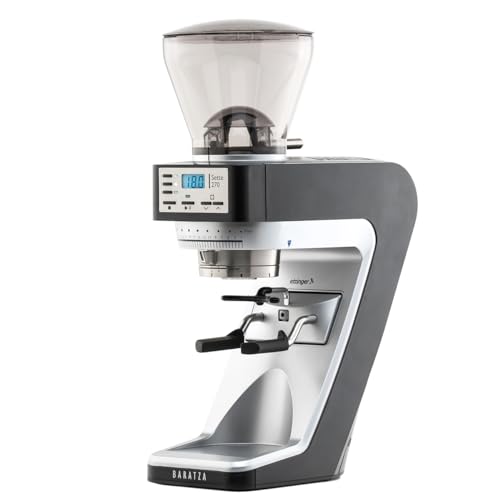
Baratza Sette 270 Conical Burr Coffee Grinder
A straight-through grind path with very low retention and macro plus micro adjustment. Fast, loud, and genuinely espresso-focused.
Check price
Fellow Ode Gen 2 Flat Burr Coffee Grinder
64mm flat burrs tuned for filter rather than espresso. Excellent at pourover, and deliberately not the right tool for a 9 bar shot.
Check pricePrices change often, confirm on Amazon. As an Amazon Associate we earn from qualifying purchases.
Does burr size or burr shape matter more?
Shape changes the taste, size changes the speed and the consistency of the taste. They are different questions and they get conflated constantly.
Conical burrs produce a wider, bimodal particle distribution: a population of larger particles alongside a population of fines. In the cup that generally reads as body, texture and a forgiving character, because the fines contribute resistance that helps a slightly imperfect puck hold together. Conical burrs also run cooler at lower speeds and cost less to make at a given quality, which is why the entry band is full of them.
Flat burrs produce a narrower, more unimodal distribution. In the cup that generally reads as clarity: individual flavours separate rather than blending into one impression. That suits lighter roasts and single origins, and it is less forgiving, because a narrow distribution transmits puck prep errors straight through to the shot. If you are weighing flat against conical properly, conical versus flat burrs sets out the tradeoff without the brand noise.
Size mostly buys throughput and alignment tolerance. Bigger burrs cut each bean fewer times as it passes, grind faster, and are easier to keep parallel because the mounting surfaces are larger. A 64 mm flat set will grind an 18 g dose noticeably faster and cooler than a 40 mm conical one, and heat is the enemy of aromatics. That is the real argument for the DF64 II over a small conical grinder at half the price, and the Specialita versus DF64 comparison covers what another $150.00 buys above this band.
What does retention actually cost you?
Retention is the coffee left inside the grinder after a dose, sitting in the chute, on the burr carrier and in the exit path, which then comes out mixed into the next dose. Whether it matters depends entirely on how you use the grinder.
If you single dose, weighing 18 g of beans in and expecting 18 g of grounds out, retention is the difference between the recipe you intended and the one you brewed. A grinder holding 2 g means your 18 g dose is 16 g of today plus 2 g of yesterday, stale and ground at whatever setting you were using then. Change beans and the first dose is a blend of two coffees you did not choose to blend. This is the entire reason the Mignon Zero has a bellows and the DF64 II has a near-zero grind path.
If you grind from a full hopper with one bean, retention barely matters. The coffee inside is the same coffee, ground at the same setting, minutes rather than days old. Many people spend $150 solving a problem their workflow does not have, and they would have been better served putting that money into adjustment resolution.
The workflow test is simple. Count how many different bags of coffee pass through the grinder in a month. Under two, retention is a footnote. Three or more, and it is the second most important specification on the page after adjustment.
What else separates grinders once resolution is solved?
Three things, and all of them are second order compared with adjustment, which is why they belong here rather than at the top of the page.
Burr alignment is the quiet one. If the two burrs are not perfectly parallel, the gap is smaller on one side than the other, and a single rotation produces two different particle sizes. Bigger burrs are easier to align because the mounting surfaces are larger, which is part of why a 64 mm flat set behaves more predictably than a 40 mm one. Alignment is rarely published and is one of the few specifications where paying more genuinely buys tighter tolerances.
Heat is the second. Grinding is friction, friction is heat, and heat drives off the volatile aromatics that make a light roast interesting. A grinder that takes 12 seconds to do a dose puts less heat into the coffee than one taking 25 seconds, and larger burrs at lower speed generate less than small burrs spinning fast. For back-to-back shots the difference compounds, which is why cafe grinders are large and slow rather than small and fast.
Workflow is the third and the one you will notice daily. A grinder that throws grounds across the counter, needs the portafilter held at an angle, or requires the hopper emptied to change beans will annoy you every morning regardless of how well it grinds. Single dose designs with a bellows and a dosing cup solve all three at once, and that convenience is a large part of what the $329.00 and $399.00 grinders on this page are actually selling.
Who should not buy the top of this band?
Anyone brewing medium-dark supermarket beans on a pressurised basket. A pressurised, or dual-wall, basket has a single small hole behind a second wall and generates its own back pressure, which is how it produces crema from almost any grind. That design deliberately makes the grinder less important, and it also caps how good the result can be. Put a $399.00 stepless flat burr grinder in front of it and most of what you paid for is neutralised by the basket before the coffee reaches the cup.
Buy the Baratza Encore ESP at $199.95 instead. You save $199.05 against the DF64 II, you still get 20 micro-adjustments inside the espresso range, and Baratza publishes parts diagrams and sells every wear part, so the grinder is repairable rather than disposable. Spend the difference on a non-pressurised precision basket and a distribution tool, which will change the cup far more than the burr upgrade would have.
Anyone with a budget under $200 in total should look at hand grinders. This is worth saying plainly because it contradicts the shape of this page. A TIMEMORE Chestnut C3 ESP at $99.00 out-grinds most electric grinders under $200, because it spends nothing on a motor, a housing or a hopper and puts the whole budget into burrs, an adjustment mechanism and axle stability. That is $100.95 less than the Encore ESP. The 1Zpresso J-Ultra at $199.00 sits within a dollar of the Encore ESP, at $0.95 less, and grinds better still. The tradeoff is your arm and about a minute per dose, which is covered honestly in the hand grinder roundup.
Anyone who has not yet bought a machine should not spend the whole budget here either. A grinder with nothing to grind for is not a purchase, it is a deposit. A Breville Bambino Plus at $485.00 plus the Encore ESP totals $684.95 and is a complete working setup, while the same machine plus the DF64 II totals $884.00. Both are sensible. Buying the DF64 II first and waiting three months for a machine is not.
What changes if you spend more than $500?
Less than the price jump suggests, which is the honest reason this band exists as its own page. Above $500 you are buying build quality, silence, dose automation and set-and-forget convenience rather than a fundamentally better grind.
The Eureka Mignon Specialita at $549.00 is the clearest example. It has stepless 55 mm burrs, a timed touchscreen dose and Eureka's quiet running, and it is built to grind the same drink every morning for years without being touched. That is $150.00 above the DF64 II, and what it buys is a grinder that disappears into a routine rather than one that participates in a hobby. Both grind espresso at a genuinely high level.
The step above that is large burrs, alignment guarantees and commercial motors, and it is where diminishing returns become steep for home use. If you are pulling two to four shots a day on medium roasts, the difference between a $399 stepless flat burr grinder and a $1,200 one is audible in a cupping room and marginal in a milk drink. Put that money into beans instead, kept between roughly 7 and 21 days off roast, and you will taste the change more often.
For the full picture across every price band, including what the money does above and below this one, the main espresso grinder roundup is the page to read next. It covers the same decision without the $500 ceiling constraining the answers.
Frequently asked questions
What is the best espresso grinder under $500?
The MiiCoffee DF64 II at $399.00. It has 64 mm flat burrs, stepless adjustment and near-zero retention, which means you can land anywhere between two settings and the weight you put in is close to the weight you get out. Below it, the Eureka Mignon Zero at $329.00 gives you stepless 55 mm flat burrs, and the Baratza Encore ESP at $199.95 is the sensible floor.
Why does stepless adjustment matter for espresso?
Because espresso lives inside a narrow band of grind sizes and a stepped grinder can jump straight over the setting you want. If one click moves a shot by four or five seconds and your target is 25 to 30 seconds, the click either side of correct lands outside the window. Stepless adjustment has no clicks, so you can stop anywhere between two positions and change the shot by a second.
Are flat burrs better than conical burrs for espresso?
They produce a different result rather than a strictly better one. Flat burrs make a narrower, more unimodal particle distribution, which reads in the cup as clarity and separation of flavours. Conical burrs make a wider bimodal distribution, which reads as body and tends to be more forgiving of a slightly imperfect puck. Flat is generally preferred for light roasts, conical for milk drinks and easier workflow.
What is retention and does it actually matter?
Retention is the coffee left inside the grinder after a dose, which comes out mixed into your next one. It matters if you change beans often or single dose, because 2 g of yesterday stale grounds inside an 18 g dose is a real dilution of what you are tasting. If you grind one bean continuously from a full hopper, retention matters much less than the internet suggests.
Is a $399 grinder worth it with a $299 espresso machine?
Yes, and that pairing is often better than the reverse. Grind size is the only variable that meaningfully controls how long a shot takes, so the grinder sets the ceiling on how good your espresso can be while the machine mostly controls how repeatable and how fast it is. A modest machine with a good grinder pulls better coffee than an expensive machine with a poor one.
Should you buy a hand grinder instead at this budget?
Under about $200, seriously consider it. A $99.00 TIMEMORE Chestnut C3 ESP has finer adjustment and better burr alignment than most electric grinders at the same money, because a hand grinder spends nothing on a motor. Above roughly $200 the argument flips, since electric grinders in the $329 to $399 band win on speed, dose consistency and effort with no grinding by hand at all.
How we choose: we compare published manufacturer specifications, verified owner reviews and published barista guidance. We do not test gear in person. Espresso machines run mains electricity, pressurised water and steam above boiling point, so follow your manufacturer's manual and leave electrical or boiler work to a qualified technician. Everything here is researched guidance, not professional advice.